Choosing a WhatsApp automation platform in 2026 means weighing a usage-based API toolkit against an all-in-one business inbox. Twilio bills per message and leaves bot logic, inbox, and channel management to you. Com.bot bundles those pieces into one platform.
This comparison shows how Com.bot's visual bot builder, unified multi-channel inbox, and native WhatsApp payments stack up against Twilio Studio, then breaks down pricing, integrations, and bulk messaging. You will finish knowing which platform fits your team, budget, and support volume, plus a clear verdict.
Quick Verdict: Twilio vs Com.bot for WhatsApp Chatbot Automation in 2026
For most businesses seeking a no-code, all-in-one WhatsApp chatbot automation solution in 2026, Com.bot is the clear winner, while Twilio remains the top choice for developers building custom, large-scale messaging infrastructure. The two platforms solve the same core problem, connecting businesses to customers on WhatsApp, but they take opposite routes to get there.
Com.bot is built for speed. As an official Meta Business Partner, it gives teams a visual chatbot builder, a unified inbox for managing conversations, and native WhatsApp payments, all under predictable pricing. Twilio, by contrast, is a cloud communications and CPaaS provider whose WhatsApp Business API access is designed for engineers who want programmable messaging control.
| Consideration | Com.bot | Twilio |
|---|---|---|
| Setup approach | Quick setup and integration with a visual, no-code chatbot builder | Programmable API requiring developer work |
| Best for | Businesses prioritizing speed and ease of use | Developers building custom, large-scale messaging infrastructure |
| Messaging scale | 25M+ messages processed daily | General cloud communications scale, described in broad terms |
| Pricing model | No markup on WhatsApp conversations | Usage-based CPaaS pricing, varies by configuration |
The scale behind Com.bot matters here. It serves 23,000+ active customers, including 100+ government bodies, and supports 500+ global partners, with 100K+ bots created on the platform. That track record reflects a product tuned for teams that want conversational AI running quickly rather than assembled from scratch.
Twilio's strength is flexibility. Its programmable messaging layer suits organizations with in-house engineering resources and unusual routing, compliance, or data requirements. That flexibility comes with a longer build cycle and more moving parts to maintain.
The practical takeaway is simple. If you want customer engagement, lead generation, or e-commerce flows live without hiring developers, Com.bot fits. If you are a developer team that needs full control over every webhook and message route, Twilio fits. For most readers of this comparison, the faster path wins.
At a glance: how Com.bot compares to Twilio, Com.bot for WhatsApp Chatbot Automation in 2026 on the features that matter most.
| Feature | Com.bot | Twilio | Com.bot for WhatsApp Chatbot Automation in 2026 |
|---|---|---|---|
| WhatsApp Chatbot Automation | ✓ | ✓ | — |
What Is Com.bot?
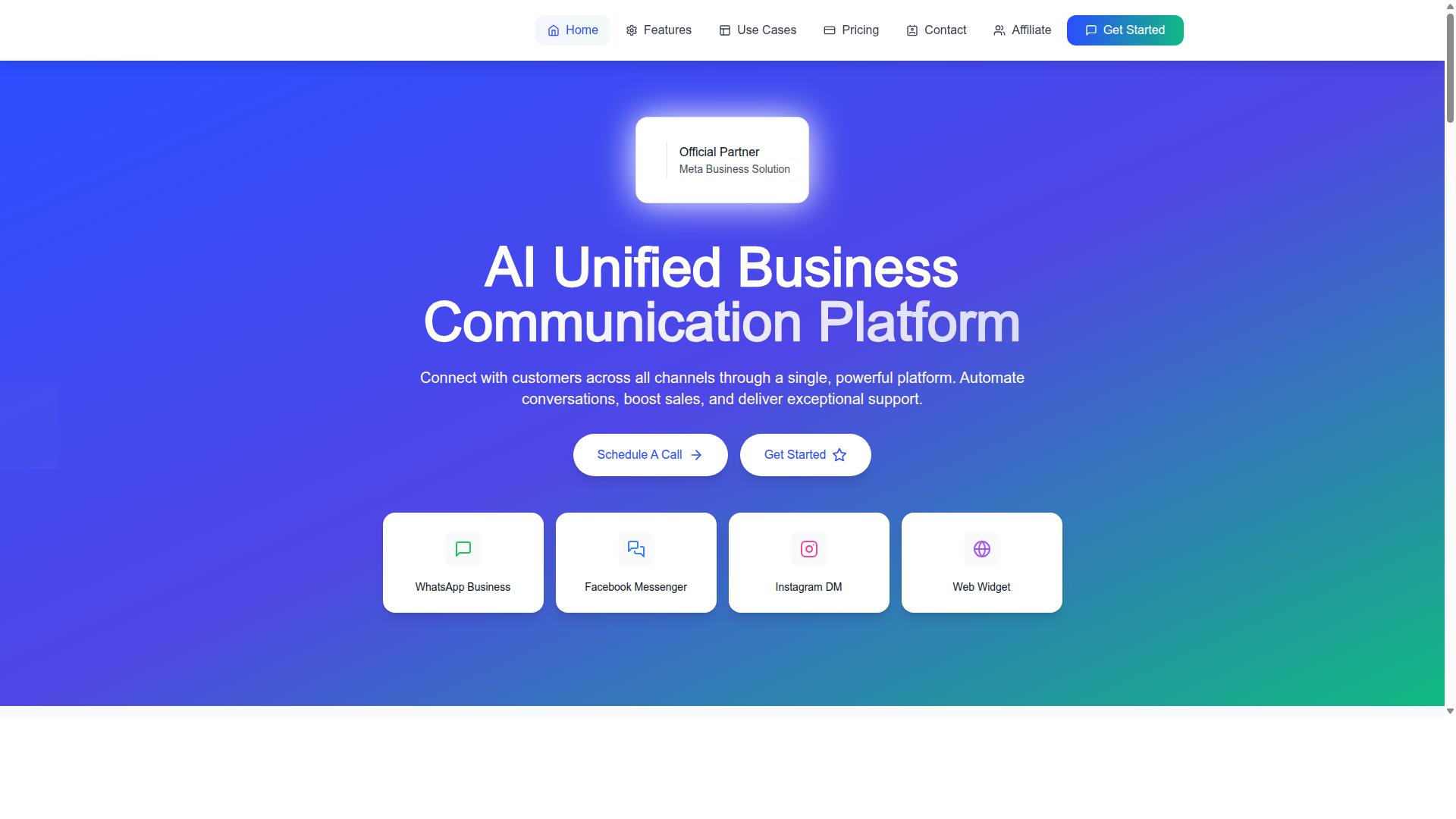
Com.bot is an AI-powered Unified Business Communication Platform that connects WhatsApp Business, Facebook Messenger, Instagram DM, and Web Widget into a single interface for seamless customer engagement. Owned and managed by Com Bot AI Limited, it is built for businesses that want to automate conversations, boost sales, and deliver strong support without juggling disconnected tools.
Where traditional cloud communications platforms focus on programmable messaging, Com.bot takes a unified platform approach. It brings automation, team collaboration, and payments together so that a single conversation can move from inquiry to purchase without leaving the interface.
At the center of the platform is a visual chatbot builder. Teams can design conversational flows for common journeys such as product questions, order tracking, or appointment booking, then refine them as real customer data comes in. Because it is a no-code environment, the people closest to the customer can build and update flows directly.
Com.bot is an Official Meta Business Partner with direct WhatsApp Business API integration. That status matters for chatbot automation because it means businesses work through the official WhatsApp Business Platform rather than an unofficial workaround, which supports reliable message delivery and long-term account stability.
Beyond the bot itself, Com.bot pairs automation with a unified team inbox, so human agents can step into any conversation across channels when a query needs a personal touch. Native payments let customers complete transactions inside the chat, which shortens the path from interest to purchase. These capabilities support lead generation, e-commerce, and customer support from one place.
The platform serves businesses in 50+ countries with enterprise-grade security. That combination of reach and security posture suits growing teams as well as larger organizations that need oversight without slowing down daily operations.
In short, Com.bot is best understood as an omnichannel messaging and automation hub. It is aimed at businesses that want WhatsApp chatbot automation as part of a broader customer engagement strategy, not as an isolated tool. Later sections cover how it compares feature by feature with Twilio.
What Is Twilio?
Twilio is a cloud communications platform (CPaaS) that provides programmable APIs for developers to integrate messaging, voice, and video capabilities into applications. In practice, it acts as a building block rather than a finished product, giving engineering teams the raw tools to construct their own communication flows from the ground up.
Its core strength is flexibility. Because everything runs through APIs, a development team can shape messaging logic to almost any specification. That same openness, however, is also the source of its complexity, since nothing works until someone writes the code to make it work.
Twilio supports the WhatsApp Business API, which means businesses can send template messages, session messages, and interactive formats such as quick replies, buttons, and list messages through Meta's WhatsApp Business Platform. The catch is that connecting these pieces requires meaningful development effort.
Teams typically need to handle several layers before a single automated reply goes live:
- Registering and verifying a WhatsApp Business account through Meta
- Setting up webhooks to receive and route incoming messages
- Writing logic to interpret user intent and trigger the right response
- Managing message templates, session windows, and approval workflows
- Connecting the stack to a CRM such as Salesforce, HubSpot, or Zendesk
Twilio's global reach and scalability are genuine advantages for high-volume, engineering-led organizations. The trade-off is time. Building chatbot automation this way can take weeks or months of developer hours, and ongoing maintenance falls on the same team.
For a business that wants conversational AI, lead generation, or e-commerce support running quickly, a developer-first platform like Twilio sets a high technical bar. That gap is precisely where no-code and low-code chatbot builders enter the conversation, letting teams launch WhatsApp automation without assembling the plumbing themselves.
What Is Com.bot for WhatsApp Chatbot Automation in 2026?
In 2026, Com.bot stands out as a purpose-built platform for WhatsApp chatbot automation, offering a drag-and-drop visual bot builder that requires no coding and integrates natively with WhatsApp Business API. Instead of writing scripts and managing webhooks by hand, teams assemble conversations visually and publish them to WhatsApp.
That difference in approach shapes everything that follows in this comparison. Com.bot is designed for marketers, support leads, and operations teams who want results from chatbot automation without a developer in the loop. Twilio, by contrast, is a cloud communications and CPaaS provider whose programmable messaging model expects engineers to build and maintain the logic themselves.
The Visual Bot Builder sits at the center of Com.bot's WhatsApp offering. Its drag-and-drop interface lets a business map out branching conversational flows, then connect those flows to the rest of the platform through the Automation Builder and its 1000+ integrations.
For messaging itself, Com.bot supports the message types that matter most on WhatsApp:
- Broadcast messaging for reaching contact lists at scale
- Template messages for approved, outbound business-initiated conversations
- Interactive messages including quick replies, buttons, and list messages
- Media messages for richer, non-text content
These capabilities are what turn a chatbot from a novelty into a working channel for customer engagement, lead generation, and e-commerce conversations.
Com.bot also pairs the bot layer with a Unified Team Inbox, so human agents can step into a conversation when automation is not the right answer. Multi-Channel Support extends the same setup to Facebook and Instagram, and Native Payments allows WhatsApp transactions to happen inside the conversation rather than being redirected elsewhere.
Scale is where the platform's track record becomes relevant. Com.bot processes 25M+ messages per day and has created 100K+ bots, figures that speak to reliability under real production volume rather than a demo environment.
The practical contrast with Twilio comes down to who does the building. Twilio's programmable messaging gives engineering teams deep control, but that control arrives as code: API integration, webhook handling, and message routing logic all sit with the developer. Com.bot trades some of that low-level flexibility for speed, putting the same channel in the hands of people who think in flows rather than functions.
| Aspect | Com.bot | Twilio |
|---|---|---|
| Build approach | Visual Bot Builder with drag-and-drop interface, no coding | Programmable messaging, generally code-driven |
| WhatsApp channel | Native WhatsApp Business API integration | WhatsApp support via its cloud communications platform |
| Message types | Broadcast, template, interactive (quick replies, buttons, lists), media | Handled through programmable APIs |
| Team workflow | Unified Team Inbox with role-based access | Typically assembled from separate tools |
| Payments | Native Payments for WhatsApp transactions | Not a core part of the messaging layer |
For a reader weighing chatbot automation rather than custom telecom infrastructure, the takeaway is straightforward. Com.bot is built to get a working WhatsApp bot live quickly, while Twilio is built to be programmed. The next sections examine where each approach fits best.
Features Compared
This section compares the key features of Com.bot and Twilio for WhatsApp chatbot automation, focusing on bot building, multi-channel support, payments, integrations, and bulk messaging capabilities.
The two platforms take very different paths to the same destination. Com.bot is an all-in-one, no-code solution built for teams that want to launch and manage WhatsApp chatbots without writing code.
Twilio, by contrast, is a flexible, developer-centric API platform. It is part of the cloud communications and CPaaS world, where programmable messaging and API integration sit at the centre of every build.
That difference shapes everything that follows. The table below sets the stage before each category is examined in detail.
| Feature Area | Com.bot | Twilio |
|---|---|---|
| Bot building | Visual, drag-and-drop builder | Studio plus custom code for advanced logic |
| Multi-channel inbox | Unified Team Inbox | Not a built-in offering |
| WhatsApp payments | Native Payments | Typically requires third-party tools |
| Integrations | Automation Builder with 1000+ integrations | Possible via APIs, custom development |
| Bulk messaging | Bulk Messaging and Order Updates | Supported through programmable messaging |
For a marketer or support lead, the practical question is how much engineering time each route demands. For a developer, it is how much control the platform hands back. Both matter, and each subsection below weighs them.
WhatsApp Chatbot Automation: Visual Bot Builder vs Twilio Studio
Com.bot's visual bot builder enables users to design WhatsApp chatbot flows using a drag-and-drop interface, while Twilio Studio offers a similar visual tool but often requires custom code for advanced logic.
The distinction matters most for who can actually ship a bot. With Com.bot, a marketer can assemble a flow, connect it to the WhatsApp Business API, and go live without a developer in the loop.
Twilio Studio gives teams a visual canvas too, but complex interactions tend to pull in TwiML or direct API calls. That is not a flaw for engineering-led organisations. It simply means the build depends on developer availability.
Adoption tells part of the story. Com.bot has created 100K+ bots, a signal that non-technical users can get to a working chatbot quickly.
Native WhatsApp features also shape the experience. Interactive messages such as quick replies, buttons, list messages, and media messages are part of the flow design in Com.bot, so conversational AI feels natural to the end customer rather than bolted on.
For teams weighing chatbot automation against engineering capacity, the no-code route usually wins on speed. For teams with deep API needs and in-house developers, Twilio's programmatic approach remains a reasonable fit.
Unified Multi-Channel Inbox and Native WhatsApp Payments
Com.bot provides a unified team inbox that consolidates WhatsApp, Facebook Messenger, Instagram DM, and Web Widget conversations, along with native payment processing for WhatsApp transactions.
This combination addresses two problems that usually get solved separately. First, agents stop switching between dashboards. Every conversation lands in one place, which supports omnichannel messaging without extra tooling.
Second, payments happen inside the chat. Com.bot's Native Payments lets customers complete a transaction during the conversation, which shortens the path from interest to purchase. Payment Collection sits alongside notifications and order updates as a core use case.
Twilio does not offer a built-in unified inbox or a native payment solution. Teams typically integrate third-party tools or build custom workflows through the API. That is workable, but it adds moving parts and coordination overhead.
The practical difference is deployment speed. A support or e-commerce team on Com.bot can run conversations and collect payments from one platform, while a comparable Twilio setup often spans several vendors.
Role-based access and Team Collaboration features keep that shared inbox manageable as headcount grows, so customer engagement does not depend on a single agent's memory.
Integrations, Bulk Messaging and Order Updates
Com.bot offers pre-built integrations with popular CRM and e-commerce platforms like Salesforce, HubSpot, Zendesk, Shopify, and WooCommerce, and supports bulk messaging for order updates and promotions.
The Automation Builder ties these together with 1000+ integrations, so connecting a CRM or storefront does not require heavy development. Data flows between systems and the chatbot without a custom middleware project.
Bulk messaging leans on the WhatsApp Business Platform's message types. Template messages handle notifications sent outside the 24-hour window, such as order confirmations and shipping alerts, while session messages cover replies within an active conversation. Order Updates use this structure to keep customers informed at each stage.
Broadcast messaging for promotions follows the same logic. Teams can reach a segmented audience with approved templates, then hand the reply back to the inbox for a human or bot to handle.
Twilio supports these capabilities too, but integrations generally run through APIs and require custom development. That flexibility suits engineering teams with specific architectures.
For most support, e-commerce, and lead generation teams, the deciding factor is time to value. Com.bot's native integrations and bulk messaging reduce setup complexity, which keeps chatbot automation focused on customer engagement rather than plumbing.
Pricing Compared
Pricing is a critical factor in choosing between Com.bot and Twilio, with Com.bot offering predictable subscription plans and Twilio charging based on usage. That single structural difference shapes how each platform feels to a finance team, a founder, or an agency managing client budgets.
Com.bot uses tiered subscription plans, so the core cost is known before the month begins. Twilio follows a pay-as-you-go model, where the bill grows alongside message volume and API activity. Neither approach is inherently wrong, but they suit different planning styles.
For businesses running WhatsApp chatbot automation on the WhatsApp Business API, predictability matters. Subscription pricing makes it easier to forecast spend across a quarter, while usage-based billing rewards low-volume periods but adds variability when campaigns scale up.
The detailed breakdown below covers what each Com.bot tier includes and how Twilio's consumption model behaves as conversational AI workloads expand.
Com.bot Plans vs Twilio's Usage-Based WhatsApp Pricing
Com.bot offers three subscription tiers: Silver at $149 per quarter, Gold at $349 per quarter (recommended), and Platinum V1 at $2500 per quarter, with add-ons available, whereas Twilio charges per message and per API call.
The Gold Plan is the recommended tier, which suggests it covers the needs of most teams building chatbot automation, lead generation, and customer support flows. Silver suits smaller operations testing conversational AI, while Platinum V1 targets larger deployments with heavier requirements.
Beyond the base plans, Com.bot keeps expansion costs visible through add-ons priced at $10 per month for an additional team member, social channel, external actions (per 5000), bot triggers (per 25000), or an ecom store. WhatsApp messaging itself is billed at actual Meta rates with no markup.
Dedicated support is also available by the hour: WABA, CRM, and Inbox support at $49/hour, and Ecommerce, Bots, and Automations support at $99/hour. All pricing is listed in USD, though the site offers an INR toggle, so buyers should confirm their billing currency.
| Aspect | Com.bot | Twilio |
|---|---|---|
| Pricing model | Tiered quarterly subscription | Pay-as-you-go, usage-based |
| Entry tier | Silver at $149 per quarter | Varies with volume |
| Recommended tier | Gold at $349 per quarter | Not applicable |
| Top tier | Platinum V1 at $2500 per quarter | Not applicable |
| Add-ons | $10 per month each for team members, social channels, external actions, bot triggers, ecom store | Costs scale with messages and API calls |
| WhatsApp messaging | Actual Meta rates, no markup | Billed per message and per API call |
| Budget predictability | High, fixed plan plus optional add-ons | Lower, depends on traffic and usage |
Twilio's model can work well for teams with steady, low-volume traffic or those already embedded in its cloud communications ecosystem. The trade-off is that costs scale with message volume and API usage, which makes budgeting harder during broadcast campaigns or seasonal spikes.
Com.bot's plans bundle core features into a transparent quarterly figure, so budgeting becomes a planning exercise rather than a forecasting gamble. For teams comparing chatbot builders on total cost of ownership, that clarity is a meaningful advantage.
Who Should Choose Com.bot
Com.bot is ideal for businesses and government bodies that need to automate and scale customer communication across WhatsApp, Facebook, and Instagram without extensive technical resources. The platform is built as an all-in-one solution, so teams can move from setup to live chatbot automation quickly instead of stitching together separate tools for messaging, payments, and support.
That combination matters in 2026, when customers expect fast replies on the channel they already use. A no-code platform removes the dependency on developers that often slows down WhatsApp Business API projects. Staff can build flows, manage conversations, and launch campaigns directly, which shortens deployment timelines considerably.
Com.bot serves a broad mix of organizations. It is trusted by 23,000+ active customers, supports 100+ government bodies, and works with 500+ global partners. That scale suggests the platform fits both small teams testing their first chatbot and large agencies handling high message volumes across regions.
Small and medium businesses usually pick Com.bot for speed and simplicity. Enterprises and government agencies choose it when they need unified oversight of many conversations, consistent messaging across departments, and a deployment path that does not require a large engineering team. The same platform scales from a single support inbox to multi-channel operations.
Teams weighing Com.bot against Twilio should consider their internal resources first. Twilio is a strong cloud communications and CPaaS option, and its programmable messaging approach suits companies with developers who want to build custom logic through API integration and webhooks. That flexibility is real, but it also means more setup work and ongoing maintenance.
Com.bot takes a different route. A unified inbox brings WhatsApp, Facebook, and Instagram conversations into one place, which helps support and sales teams avoid switching between dashboards. Native payments let businesses collect money inside the chat flow, useful for e-commerce, order updates, and service fees. Bulk messaging and template messages cover announcements, reminders, and promotions.
- Small to medium businesses that want chatbot automation without hiring developers
- Enterprises managing multi-channel customer support and lead generation at scale
- Government bodies needing reliable broadcast messaging and payment collection
- E-commerce teams handling order updates, quick replies, and interactive messages
- Agencies and partners deploying chatbots for multiple clients from one platform
Quick deployment is a deciding factor for many of these groups. When a business needs a working WhatsApp chatbot within days rather than months, a no-code builder and ready features reduce the risk of stalled projects. Com.bot's customer engagement tools are designed around that reality.
The trade-off is customization depth. Organizations with highly specialized logic may still prefer a programmable messaging stack. For most teams focused on customer support, lead generation, and payments, Com.bot's all-in-one approach delivers faster value with less technical overhead.
Who Should Choose Twilio
Twilio is best suited for developers and companies that require highly customized, scalable messaging solutions and have the technical expertise to build on APIs. The platform has long been recognized as a leading cloud communications provider, and its CPaaS foundation gives teams direct access to the WhatsApp Business API through programmable messaging tools.
That level of access appeals to a specific audience. If your organization treats messaging infrastructure as a core engineering asset rather than a business tool, Twilio's model tends to align well with that philosophy. The trade-off is that flexibility arrives with responsibility. Someone on your team has to design, build, and maintain the logic behind every conversation flow.
Below are the profiles that typically get the most value from a developer-first approach to WhatsApp chatbot automation.
- Large enterprises with in-house development teams. Organizations that already run dedicated engineering squads can absorb the setup work and tailor message routing, webhooks, and integrations to internal systems on their own terms.
- Startups building unique communication workflows. When the conversation experience itself is the product differentiator, building from raw APIs can make sense. A custom flow is easier to own end to end when it runs on infrastructure you control.
- Businesses needing granular control over messaging infrastructure. Teams with strict compliance, data residency, or architectural requirements often prefer to manage the stack directly rather than work within a pre-built environment.
- Companies with existing Twilio investments. If SMS, voice, or other channels already run through the same account, consolidating WhatsApp into that setup reduces the number of vendors to manage.
In each of these cases, the deciding factor is usually the same. Flexibility and custom integration sit at the top of the priority list, and the team is comfortable owning the technical lift that comes with it.
It is worth being honest about the other side of that equation. Developer-first platforms generally assume you will handle chatbot logic, conversation design, and ongoing iteration yourself, or hire for it. That is not a flaw, it is the design. But it does mean time-to-launch depends heavily on internal engineering capacity rather than on a ready-made tool.
For teams without that capacity, the calculus shifts. A no-code or low-code chatbot builder can shorten the path from idea to live WhatsApp automation, which is why many businesses weigh both routes before committing. The right answer depends on whether your bottleneck is engineering resources or speed to market.
If your team has the developers, the appetite for custom work, and a genuine need for granular control, Twilio remains a reasonable fit for WhatsApp chatbot automation in 2026. If those conditions are not in place, a more guided platform is likely to deliver value sooner.
Who Should Choose Com.bot for WhatsApp Chatbot Automation in 2026
For WhatsApp chatbot automation in 2026, Com.bot is the preferred choice for businesses that want to deploy intelligent chatbots quickly, manage all conversations in one place, and process payments natively.
Twilio is a strong CPaaS platform, and its programmable messaging tools suit engineering teams with the resources to build on raw APIs. Com.bot takes a different path. It is an official Meta Business Partner with a no-code chatbot builder, which means the same WhatsApp Business Platform can be reached without a heavy development cycle.
That difference matters most to teams that measure launch time in days rather than quarters. Com.bot processes 25M+ messages per day, so reliability is proven at real scale rather than assumed.
Teams That Feel the Difference Most
Com.bot fits organizations where speed, ownership, and conversation volume matter more than low-level API control. The platform is trusted by 23,000+ active customers, including 100+ government bodies and 500+ global partners, which shows the fit spans both public sector and commercial use.
- E-commerce and retail teams that want WhatsApp to handle product questions, order updates, and checkout without sending buyers to another app.
- Customer support leaders who need one unified inbox instead of juggling multiple tools and handoffs.
- Marketing and lead generation teams running broadcast messaging, template messages, and interactive messages such as quick replies, buttons, and list messages.
- Small and mid-sized businesses without dedicated developers who still want a professional WhatsApp presence.
- Agencies and partners managing chatbot builds for multiple clients from a single environment.
Twilio remains a reasonable choice for companies with in-house engineers who want full control over every webhook and message routing decision. That control comes with configuration work that many teams would rather spend on customer engagement instead.
Why the Visual Builder Shortens Time-to-Market
A no-code platform removes the biggest bottleneck in WhatsApp chatbot automation: the gap between a good idea and a working bot. Com.bot's visual builder lets teams design flows, add logic, and publish without writing code or maintaining API integrations.
Twilio's developer-centric model typically requires custom code for conversation logic, state handling, and webhook management. That approach is flexible, but it pushes launch timelines out and keeps engineering involved long after the first release.
The track record speaks to how repeatable this is. More than 100K bots have been created on Com.bot, and quick setup and integration keeps the path from signup to live bot short. For a marketing team that wants a campaign bot running this week, that gap is the whole decision.
One Inbox, Native Payments, and Pre-Built Integrations
Chatbot automation only delivers value when the surrounding workflow holds together. Com.bot combines a unified inbox with native payments, so a conversation can move from question to purchase without leaving WhatsApp or handing off to a separate payment tool.
Pre-built integrations connect the bot to the systems a business already runs, including CRM integration and e-commerce platforms. Twilio generally expects teams to assemble these connections themselves, which adds cost and maintenance over time.
| Capability | Com.bot | Twilio |
|---|---|---|
| Bot building | Visual, no-code builder | Programmable APIs, code required |
| Meta relationship | Official Meta Business Partner | General platform access |
| Conversation handling | Unified inbox | Typically assembled from separate tools |
| Payments | Native payment support | Usually handled via external gateway |
| Pricing on conversations | No markup on WhatsApp conversations | Platform fees apply on top of usage |
The financial detail reinforces the operational one. Com.bot applies no markup on WhatsApp conversations, which keeps message costs predictable as volume grows. Twilio's pricing model is usage-based and layered, so total cost can be harder to forecast.
Reliability, Security, and Omnichannel Reach
Scale and trust go together in messaging. Real-time message delivery and enterprise security with end-to-end encryption mean customer conversations stay both fast and protected. That combination is what lets government bodies and large partners standardize on the platform.
Com.bot also supports omnichannel messaging, so the same conversational AI logic can serve customers across channels rather than being rebuilt for each one. Teams that start with WhatsApp often expand from there without starting over.
Twilio offers broad cloud communications coverage and a mature developer ecosystem. What it does not remove is the engineering overhead. For most businesses weighing Twilio vs Com.bot in 2026, the deciding factor is simple: Com.bot delivers a working WhatsApp chatbot faster, with fewer moving parts and a clearer cost structure.
Final Verdict
After comparing features, pricing, and use cases, Com.bot emerges as the superior choice for most businesses seeking a no-code WhatsApp chatbot automation platform in 2026, while Twilio remains a strong option for developer-led custom projects.
The two platforms solve the same core problem from opposite directions. Twilio gives engineering teams programmable messaging primitives to build on. Com.bot gives business teams a finished platform to launch on. Which one fits depends on who is doing the building and how fast the chatbot needs to go live.
For teams that want to move quickly, Com.bot's advantages cluster around four areas:
- Ease of use: a no-code chatbot builder that removes the need for API integration work before the first conversation goes live
- Unified inbox: one place for teams to handle customer conversations instead of stitching together separate tools
- Native payments: checkout handled inside the chat flow, which matters for e-commerce and lead generation use cases
- Predictable pricing: no markup on WhatsApp conversations, so costs stay tied to Meta's own rates rather than a layer on top
Reliability is the other half of the decision. Com.bot holds official Meta Business Partner status and processes 25M+ messages per day, with 23,000+ active customers, 100K+ bots created, 100+ government bodies, and 500+ global partners using the platform. For a business betting its customer support or sales channel on a chatbot, that operating history at scale is meaningful evidence.
Twilio's appeal is different, and it is a real appeal. Teams with specific customization needs, unusual routing logic, or deep cloud communications requirements may prefer a CPaaS approach where they control the stack. That flexibility comes with a trade-off: more engineering time, more integration work, and a longer path from idea to live chatbot. For developer-led projects with clear custom requirements, that trade-off can be worth it.
For most readers of this comparison, though, the calculation favors Com.bot. A no-code platform with quick setup, enterprise security with end-to-end encryption, real-time message delivery, and no markup on conversations covers the needs of customer support, e-commerce, and lead generation teams without requiring a development sprint first.
If your priority is speed, simplicity, and a platform built specifically for WhatsApp chatbot automation on the WhatsApp Business Platform, Com.bot is the practical starting point. Explore what Com.bot offers for your WhatsApp automation needs and see how quickly a working chatbot can be in front of your customers.
Frequently Asked Questions
What is the main difference between Twilio and Com.bot for WhatsApp chatbot automation?
Twilio is a developer-focused communications platform where teams typically build WhatsApp messaging and chatbot logic through APIs and custom code. Com.bot is an AI Unified Business Communication Platform built for WhatsApp Business, Facebook Messenger, Instagram DM and Web Widget, with a visual drag-and-drop Bot Builder that lets teams automate conversations without heavy development work. In short, Twilio suits engineering-led builds, while Com.bot is designed for businesses that want to launch and scale multi-channel automation quickly.
Do I need technical or coding skills to build a WhatsApp chatbot with Com.bot?
No. Com.bot offers a Visual Bot Builder with a drag-and-drop interface, so you can design conversation flows, triggers and automated responses without writing code. It also includes an Automation Builder and a Unified Team Inbox, so your team can manage human handovers alongside automated chats. Setup and integration are designed to be quick, which makes it accessible to non-technical teams as well as developers.
How does Com.bot's pricing compare to Twilio's?
Com.bot's plans are published and transparent: Silver at $149 per quarter, Gold at $349 per quarter (recommended), and Platinum V1 at $2500 per quarter, with add-ons such as $10 per month for an additional team member, social channel, or per 5000 external actions and per 250 bot triggers. Twilio's pricing varies by product and usage, and its marketing plans are charged monthly based on contacts stored and emails sent, with custom quote-based options available. Because the two platforms meter different things, the best comparison is to map your expected message volume and channels against each provider's plan structure.
Which channels can I automate with Com.bot beyond WhatsApp?
Com.bot supports Multi-Channel communication across WhatsApp, Facebook and Instagram, plus a Web Widget, all managed from a single platform. That means one bot and one team inbox can handle conversations from WhatsApp Business, Facebook Messenger, Instagram DM and your website. If your customers reach out on several channels, this avoids running separate tools for each one.
Is Com.bot reliable and secure enough for large-scale or government use?
Com.bot is an Official Meta Business Partner and states that it processes 25M+ messages per day, with 23,000+ active customers, 100+ government bodies and 500+ global partners. It offers enterprise security with end-to-end encryption and serves customers in 50+ countries. For organizations with strict requirements, these credentials and the platform's global track record are worth reviewing alongside your own compliance needs.
Can I take payments and handle orders inside WhatsApp with Com.bot?
Yes. Com.bot includes Native Payments for WhatsApp transactions, so you can collect payments within the chat flow rather than redirecting customers elsewhere. Combined with automation for order updates and bulk messaging, this supports end-to-end commerce and support journeys on WhatsApp. If you want to see how this fits your specific use case, you can contact the team at [email protected] or via WhatsApp at +91 080 6987 1810.
Recommended Resources: